


Since its launch, WooCommerce has transformed the e-commerce landscape, powering millions of online stores worldwide.
But is it the right platform for your business? How are industry experts leveraging it?
To help you find the answers, we have compiled a list of insightful WooCommerce statistics that will give you a deeper understanding of the platform.
Let’s look at some key stats first.
Key WooCommerce Statistics at a Glance
- WooCommerce is powering 4,110,725 online stores globally
- More than 7 million WordPress websites have WooCommerce actively installed.
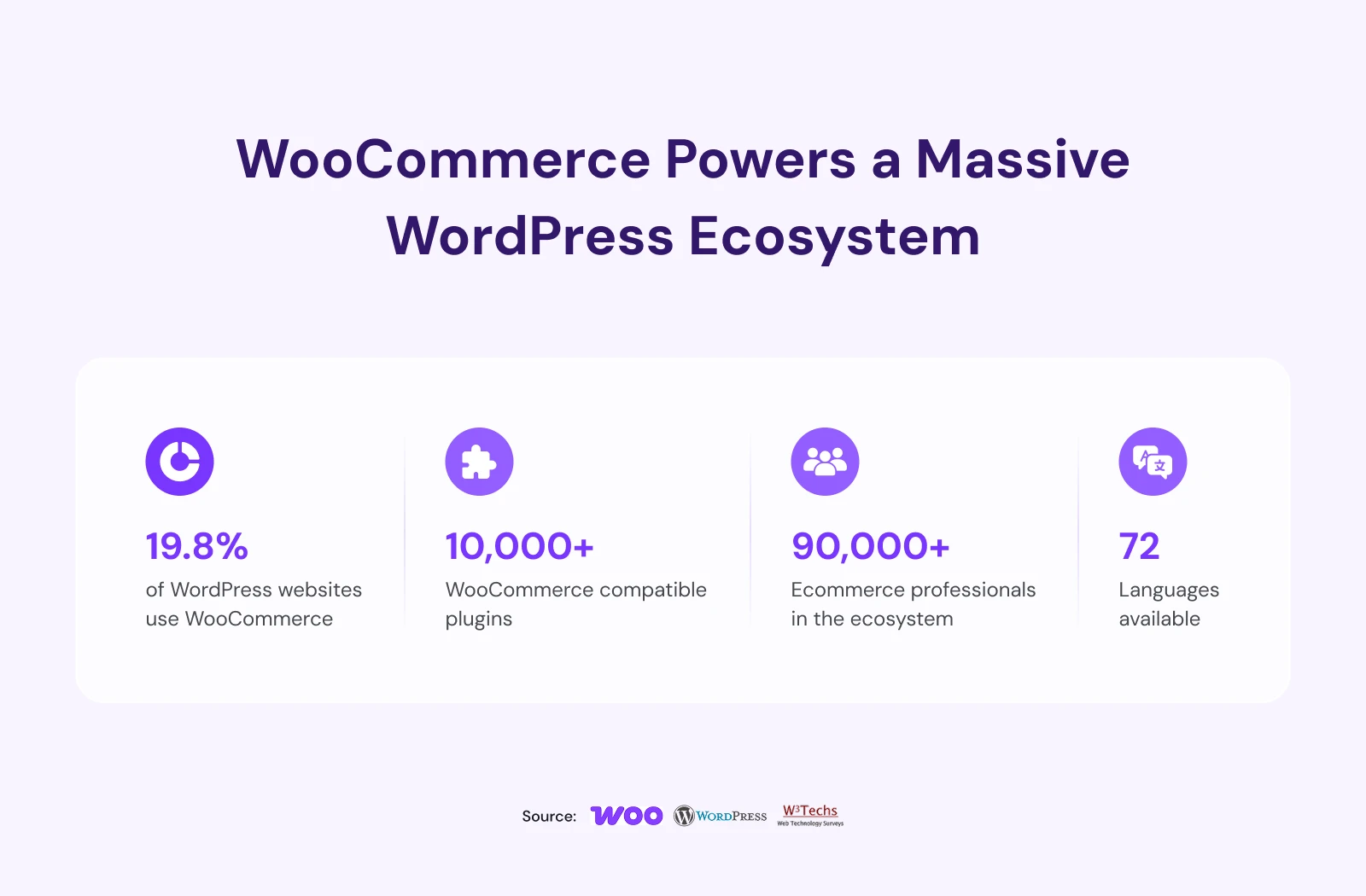
- Approximately 19.8% of WordPress websites use WooCommerce.
- Approximately 355,778 WooCommerce stores use the Astra theme (11.6% of stores.)
- One in every five websites built on WordPress uses the WooCommerce plugin.
- The average lifespan of a WooCommerce store is 4 years.
- WooCommerce stores have an average bounce rate of 53.1%.
- WooCommerce is available in 72 Languages
- WooCommerce requires PHP 7.4 or Later
We reviewed official WooCommerce sources, WordPress.org data, technology databases, analytics reports, and sales reports. We also checked how each source measures stores, installations, websites, and checkout activity.
General WooCommerce Statistics
1. WooCommerce Was Launched in 2011
WooCommerce officially launched on September 27, 2011, as a free ecommerce plugin for WordPress. (WooCommerce)
2. WooCommerce started with nine extensions
Version 1.0 launched with nine extensions and six themes, offering a small but expandable ecosystem. (WooCommerce)
3. Automattic Acquired WooCommerce in 2015
Automattic, the company behind WordPress.com, acquired WooCommerce in 2015. (WooCommerce)
4. WooCommerce has 350+ core contributors
More than 350 contributors worldwide have helped build and maintain WooCommerce's core platform. (WooCommerce)
5. The WooCommerce ecosystem includes 90,000+ professionals
Over 90,000 developers, designers, creators, and ecommerce professionals support the WooCommerce ecosystem. (WooCommerce)
WooCommerce Market Share Statistics
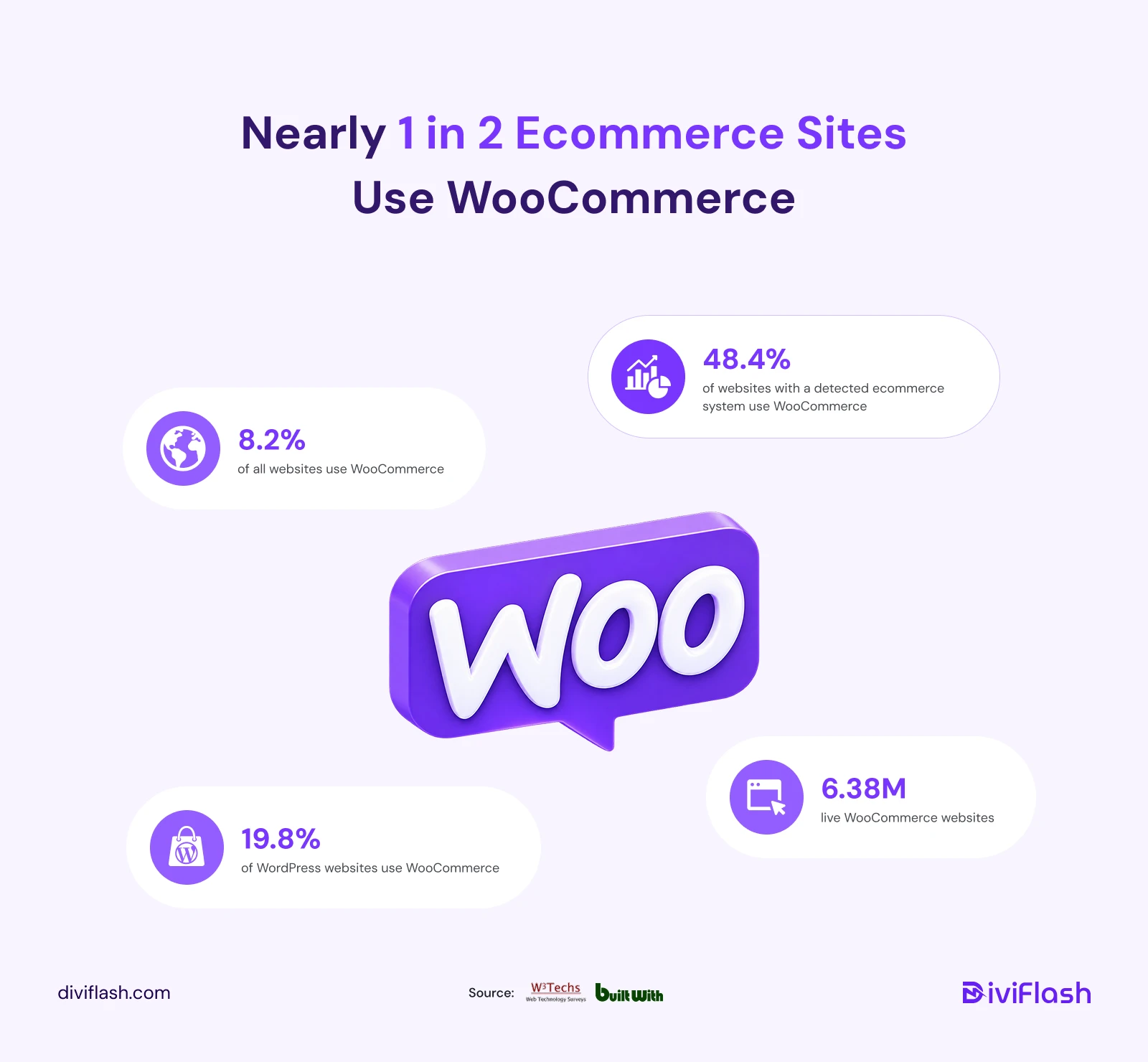
6. WooCommerce powers 8.2% of all websites
W3Techs detects WooCommerce on 8.2% of all websites across the web. (W3Techs)
7. WooCommerce holds 11.7% of the known CMS market
Among websites with an identifiable CMS, 11.7% use WooCommerce. (W3Techs)
8. WooCommerce holds 48.4% of the ecommerce market
WooCommerce powers 48.4% of websites using an identifiable ecommerce system. (W3Techs)
9. WooCommerce usage on WordPress falls to 19.8%
Its share declined from 20.4% to 19.8% over the year. (W3Techs)
10. BuiltWith detects 6.38 million live WooCommerce websites
BuiltWith currently identifies 6.38 million active websites using WooCommerce. (BuiltWith)
11. More than 12.46 million websites previously used WooCommerce
These websites are no longer detected as active WooCommerce users. (BuiltWith)
12. WooCommerce has been detected on 18.84 million websites
The total includes current, redirected, and historical websites. (BuiltWith)
13. More than 3.44 million websites have a WooCommerce checkout
BuiltWith detects an active WooCommerce checkout on 3.44 million live websites. (BuiltWith)
14. Nearly 50,000 of the top one million websites use WooCommerce
BuiltWith identifies WooCommerce on 49,788 of the world's top one million websites. (BuiltWith)
WooCommerce Usage and Growth Statistics
15. WooCommerce powers more than 4.4 million online stores
WooCommerce reports that its platform supports 4.4+ million online stores worldwide. (WooCommerce)
16. WooCommerce has more than 7 million active installations
WordPress.org reports 7+ million active WooCommerce installations across WordPress websites. (WordPress.org)
17. BuiltWith detects WooCommerce on 6.37 million live websites
BuiltWith identifies WooCommerce technology on 6.38 million live websites. (BuiltWith)
18. More than 3.44 million websites have a WooCommerce checkout
BuiltWith detects an active WooCommerce checkout on 3.44 million live websites. (BuiltWith)
19. WooCommerce holds 48.4% of the ecommerce market
Its ecommerce market share declined from 49.6% to 48.4%, while remaining the market leader. (W3Techs)
20. 19.8% of WordPress websites use WooCommerce
WooCommerce's share of WordPress websites fell from 20.5% to 19.8% over the past year. (W3Techs)
21. 83% of WooCommerce stores use version 10.x
About 42% of stores in Metorik's dataset were running WooCommerce 10.5, the latest version at the time. (Metorik)
22. WooCommerce's share of all websites fell to 8.2%
Its share declined from 9% to 8.2% between July 2025 and July 2026, a drop of 0.8 percentage points. (W3Techs)
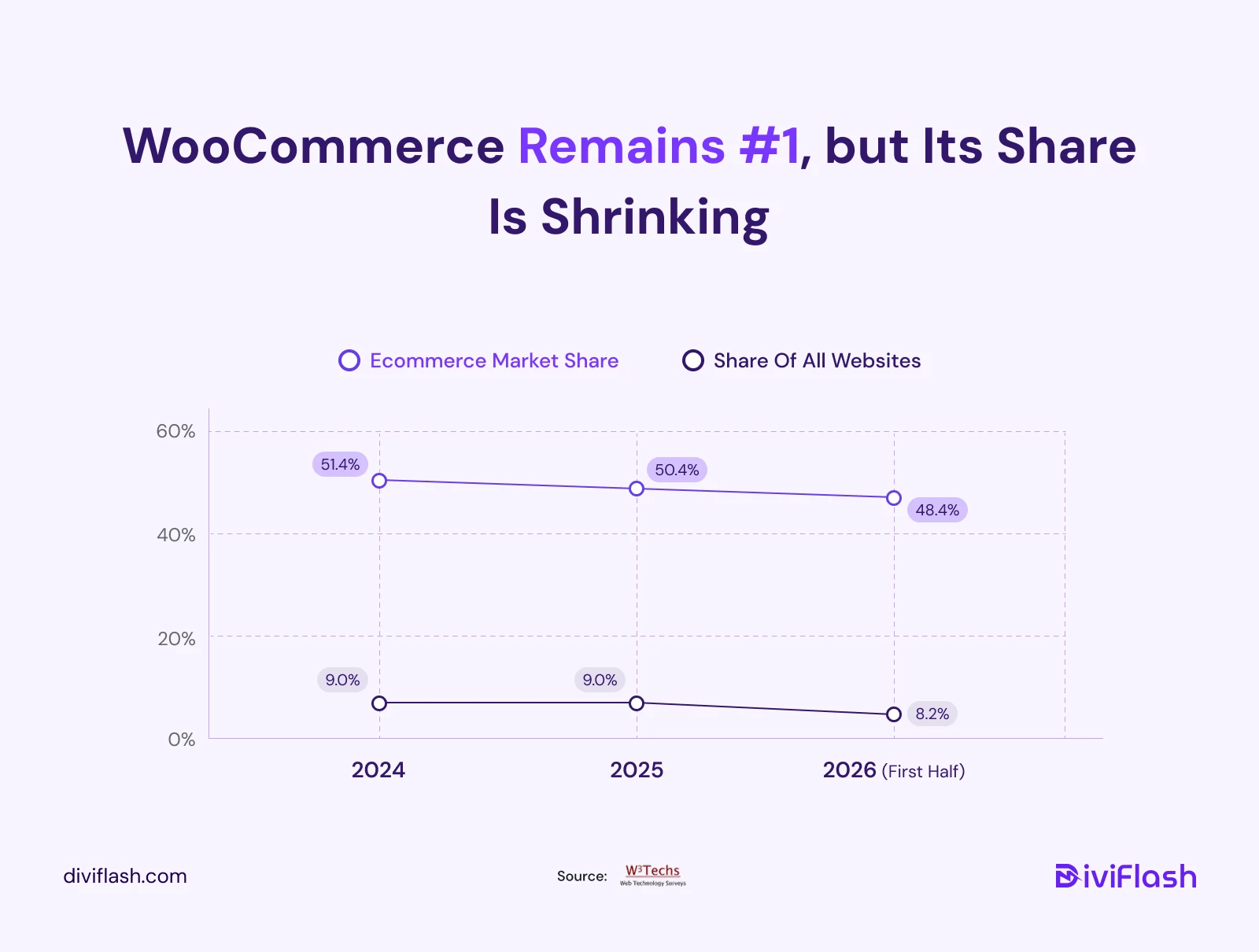
23. WooCommerce's ecommerce market share fell to 48.4%
Its share of the detected ecommerce market declined from 51.4% to 48.4% over the past year, while remaining the market leader. (W3Techs)
24. WooCommerce lost 2% of ecommerce market share in 2026
Its market share dropped from 50.4% to 48.4% in the first half of 2026. (W3Techs)
WooCommerce Sales Statistics
These WooCommerce sales statistics cover average order value, refunds, recovered carts, net sales, and payment performance.
25. The average WooCommerce order value is $105
Metorik analyzed 65+ million orders and found an average order value of $105. (Metorik)
26. Bank transfers have the highest average order value
Bank-transfer orders average $281, compared with $119 for Stripe, $101 for PayPal, and $82 for WooPayments. (Metorik)
27. Stripe order values increase with store size
Average Stripe orders rise from $45 for smaller stores to $132 for stores generating over $1 million annually. (Metorik)
28. Returning customers spend 9% more per order
Returning customers spend an average of $108, compared with $99 for first-time buyers. (Metorik)
29. Free-shipping orders average $123
Orders with free shipping average $123, while paid-shipping orders average $80. (Metorik)
30. WooCommerce's average refund rate is 1.4%
The refund rate fell from 2.4% in 2023 to 1.4% in 2025, although clothing stores averaged 6.5%. (Metorik)
31. Large stores lose more money per refund
Stores earning over $1 million annually refund an average of $252 per order, compared with $122 for smaller stores. (Metorik)
32. Recovered carts are worth 49% more
Recovered carts average $174, compared with $117 for completed carts and $141 for abandoned carts. (Metorik)
33. Holiday sales generate over 20% of annual revenue for most merchants
About 73% of WooCommerce merchants earn more than 20% of their yearly revenue during the holiday shopping season. (WooCommerce)
34. Desktop orders are worth more than twice as much as mobile orders
Desktop orders average $167, compared with $71 on mobile. (Metorik)
35. Returning customers spend 9% more per order
Returning customers spend an average of $108 per order, compared with $99 for first-time buyers. (Metorik)
36. WooCommerce's average refund rate is 1.4%
The refund rate fell from 2.4% to 1.4%, while clothing stores averaged 6.5%. (Metorik)
WooCommerce Performance Statistics
37. 39% of WooCommerce stores pass Mobile Core Web Vitals
Only 39% of WooCommerce stores pass all three Core Web Vitals on mobile, meaning most fail at least one performance metric. (HTTP Archive)
38. 37% of WooCommerce stores pass Desktop Core Web Vitals
Around 37% of WooCommerce stores meet all three Core Web Vitals on desktop. (HTTP Archive)
39. 43% of WooCommerce stores achieve a good mobile LCP
Only 43% of stores meet Google's recommended Largest Contentful Paint (LCP) target on mobile. (HTTP Archive)
40. 92% of WooCommerce stores have good mobile responsiveness
About 92% of stores achieve a good Interaction to Next Paint (INP) score for responsive user interactions. (HTTP Archive)
41. 88% of WooCommerce stores have good visual stability
Around 88% of stores achieve a good Cumulative Layout Shift (CLS) score, reducing unexpected layout shifts. (HTTP Archive)
42. The average WooCommerce page weighs around 3 MB
The median WooCommerce page transfers about 3 MB of data, including images, scripts, and other assets. (HTTP Archive)
43. Images account for around 1 MB per page
Images make up about 1 MB of the average WooCommerce mobile page, making optimization essential. (HTTP Archive)
44. WooCommerce pages load around 804 KB of JavaScript
The median WooCommerce page transfers 804 KB of JavaScript from themes, plugins, and third-party tools. (HTTP Archive)
45. WooCommerce 11.0 includes 28 performance improvements
The release introduces 28 enhancements focused on performance, caching, and scalability. (WooCommerce)
46. Product caching improves WooCommerce performance by up to 12%
WooCommerce testing found product caching can improve page loading and checkout performance by 6% to 12%. (WooCommerce)
WooCommerce Customer Statistics
The customer data shows clear differences between new and returning buyers, industries, countries, and devices.
47. Returning customers spend 9% more per order
At the typical WooCommerce store, returning customers spend $108 per order, compared with $99 for first-time buyers. (Metorik)
48. New customers spend more in the overall dataset
Across all 65+ million orders, new customers average $117 per order, while returning customers average $94. (Metorik)
49. Returning pet-supply customers spend 42% more
Pet supply stores see the biggest increase, with returning customers spending 42% more than new customers. (Metorik)
50. Returning customers spend more on replenishable products
Average order values are 24% higher for vitamins, 22% for cosmetics and cannabis products, 21% for food, and 18% for health products. (Metorik)
51. Some industries see lower spending from returning customers
Returning customers spend 29% less on online learning, 15% less on electronics, and 13% less on software purchases. (Metorik)
52. Dutch stores have the highest returning-customer premium
Returning customers spend about 20% more than new customers at the typical Dutch WooCommerce store. (Metorik)
53. Distant customers spend more per order
Customers located 1,000–2,500 km away spend an average of $167 per order, compared with $77 for local shoppers. (Metorik)
54. Mobile generates 72% of WooCommerce orders

Mobile accounts for 72% of orders, while desktop orders average $167, compared with $71 on mobile. (Metorik)
WooCommerce Theme Statistics
Many WooCommerce themes are designed for online stores, but a small group accounts for much of the usage in Metorik’s dataset.
55. 44% of WooCommerce stores use a child theme
Around 44% of WooCommerce stores use a child theme to preserve customizations during theme updates. (Metorik)
56. Elementor is the most popular theme setup
Elementor is used by 9.3% of WooCommerce stores in Metorik's dataset, making it the most common theme setup. (Metorik)
57. Flatsome powers 7.4% of WooCommerce stores
Flatsome is the second-most used theme, with a 7.4% share of stores in Metorik's sample. (Metorik)
58. WoodMart and Astra each power 4.5% of stores
Both themes are used by 4.5% of WooCommerce stores in the Metorik dataset. (Metorik)
59. Shoptimizer powers 2.8% of WooCommerce stores
About 2.8% of stores in Metorik's sample use the Shoptimizer theme. (Metorik)
60. Divi powers 2.3% of WooCommerce stores
Divi is used by 2.3% of WooCommerce stores in Metorik's dataset. (Metorik)
61. Storefront powers just 0.8% of WooCommerce stores
WooCommerce's default Storefront theme is used by only 0.8% of stores in the sample. (Metorik)
62. Flatsome has more than 268,000 ThemeForest sales
Flatsome remains ThemeForest's best-selling WooCommerce theme with 268,000+ sales. (ThemeForest)
63. WordPress offers more than 2,000 WooCommerce themes
Searching for "WooCommerce" in the WordPress theme directory returns 2,000+ themes built for WooCommerce stores. (WordPress)
64. ThemeForest lists nearly 8,000 WooCommerce themes
ThemeForest offers almost 8,000 premium WooCommerce themes, making it one of the largest marketplaces for store designs. (ThemeForest)
65. The official WooCommerce marketplace offers 130 themes
WooCommerce provides 130 official themes, including 4 free options designed for seamless compatibility. (WooCommerce)
66. Premium WooCommerce themes cost about $79 per year
The average price of a premium theme on the official WooCommerce marketplace is $79 annually, including updates and support. (Colorlib)
WooCommerce Plugin and Extension Statistics
Many WooCommerce plugins add payment, marketing, security, SEO, shipping, and analytics features to the core platform.
67. The official WooCommerce Marketplace offers 1,500+ products
The WooCommerce Marketplace includes 1,500+ extensions and themes for payments, shipping, marketing, and store management. (WooCommerce)
68. The average WooCommerce store uses 58 plugins
Store owners use an average of 58 active WooCommerce plugins for ecommerce, SEO, security, performance, analytics, and other functions. (Metorik)
69. Large WooCommerce stores use 66 plugins on average
Stores generating over $1 million annually use an average of 66 active plugins. (Metorik)
70. One WooCommerce store used 237 active plugins
The largest plugin count in Metorik's dataset reached 237 active plugins on a single store. (Metorik)
71. 40% of WooCommerce stores use the Stripe Payment Gateway
The WooCommerce Stripe Payment Gateway is the most widely used WooCommerce-specific plugin, powering 40% of stores in Metorik's sample. (Metorik)
72. Yoast SEO is used by 49% of WooCommerce stores
Nearly half of WooCommerce stores use Yoast SEO, making it the most popular general WordPress plugin in Metorik's dataset. (Metorik)
73. Over 10,000 Plugins for WooCommerce
The WordPress plugin repository includes more than 10,000 plugins built specifically for or compatible with WooCommerce stores. (WordPress)
74. The WooCommerce Marketplace Offers Over 1,350 Extensions
The official WooCommerce Marketplace provides more than 1,350 extensions, including 156 free options. (WooCommerce)
WooCommerce Usage by Country
75. The United States hosts 43.4% of WooCommerce websites
The United States has the highest total number of detected WooCommerce websites, with approximately 2.77 million sites. (BuiltWith)
76. Europe accounts for 28.9% of WooCommerce websites
Around 1.84 million WooCommerce websites are located across Europe, making it the platform's second-largest region. (BuiltWith)
77. The United Kingdom is WooCommerce's second-largest market
BuiltWith detects 241,951 WooCommerce websites in the UK, followed by Germany (191,063) and India (181,919). (BuiltWith)
WooCommerce Industry Statistics
78. 25% of WooCommerce Stores Sell Subscription Products
Around one in four WooCommerce stores sell subscription products. Although adoption has declined slightly since 2023. (Metorik)
79. Cannabis Stores Discount 45% of Orders
Cannabis stores discount 45% of orders, compared with the 25% WooCommerce average, making them the most promotion-driven industry in the dataset. (Metorik)
80. Clothing Stores Have a 6.5% Refund Rate
Clothing stores have a 6.5% refund rate, far above the 1.4% WooCommerce average, largely because of sizing, fit, and style preferences. (Metorik)
81. 79% of Fitness Store Orders Come From Mobile Devices
Fitness stores receive 79% of their orders from mobile devices, the highest share among industries, highlighting the importance of mobile shopping experiences. (Metorik)
82. Cosmetics Stores Are Three Times More Likely to Reach One Million Orders
Cosmetics and skincare stores are three times more likely than average WooCommerce stores to reach one million orders, reflecting strong long-term growth. (Metorik)
WooCommerce Payment and Shipping Statistics
83. WooCommerce Supports 100+ Payment Gateways
WooCommerce supports more than 100 payment gateways, including Stripe, PayPal, Square, bank transfers, digital wallets, and regional providers. (WooCommerce)
84. 40% of WooCommerce Stores Use Stripe
Around 40% of WooCommerce stores use the official Stripe Gateway plugin, making Stripe the most popular payment solution in Metorik's benchmark. (Metorik)
85. 25% of WooCommerce Stores Use PayPal Payments
About one in four WooCommerce stores use the official PayPal Payments plugin, making it the second most widely adopted payment gateway in the dataset. (Metorik)
86. 11% of WooCommerce Stores Use WooPayments
WooPayments powers 11% of WooCommerce stores, offering merchants a payment solution built and maintained by the WooCommerce team. (Metorik)
87. WooPayments Supports 135+ Currencies
WooPayments supports payments in more than 135 currencies, making it easier for WooCommerce stores to sell to customers around the world. (WooCommerce)
88. Bank Transfers Generate the Highest Order Value
Bank-transfer orders average $281, compared with $119 for Stripe, $101 for PayPal, and $82 for WooPayments, the highest among major payment methods. (Metorik)
89. 74% of WooCommerce Orders Include Free Shipping
Nearly three in four WooCommerce orders qualify for free shipping, up from 65% in the previous Metorik report, reflecting its growing adoption. (Metorik)
90. Paid Shipping Costs an Average of $9.27
Customers who pay for shipping spend an average of $9.27 per order, providing a benchmark for delivery charges across WooCommerce stores. (Metorik)
WooCommerce Marketing, Analytics, and Integration Statistics
91. 29% of WooCommerce Stores Use Facebook for WooCommerce
Around 29% of WooCommerce stores use the official Facebook integration to sync products and support social commerce. (Metorik)
92. 26% of WooCommerce Stores Use Klaviyo
About 26% of WooCommerce stores use Klaviyo to automate email marketing and customer engagement. (Metorik)
93. 17% of WooCommerce Stores Use Mailchimp
Approximately 17% of WooCommerce stores use Mailchimp to create and manage email marketing campaigns. (Metorik)
94. 27% of WooCommerce Stores Use Google Tag Manager
Around 27% of sampled WooCommerce stores use GTM4WP to manage tracking tags and collect marketing analytics data. (Metorik)
95. 15% of WooCommerce Stores Use Google for WooCommerce
About 15% of WooCommerce stores use Google for WooCommerce to sync products with Google Shopping and other Google services. (Metorik)
96. Over 64,000 WooCommerce Websites Have 10,000+ Social Followers
BuiltWith detects more than 64,000 WooCommerce websites with at least 10,000 social media followers, highlighting the platform's strong social media presence. (BuiltWith)
WooCommerce Location and Language Statistics
97. WooCommerce Is Available in 72 Languages
WooCommerce is available in 72 languages, making it accessible to merchants and customers worldwide. (WordPress)
98. The Typical WooCommerce Store Sells to Three Countries
The average WooCommerce store receives orders from three countries, highlighting its international reach. (Metorik)
99. 20% of WooCommerce Stores Support Multiple Currencies
Around one in five WooCommerce stores accept payments in multiple currencies for international customers. (Metorik)
100. WooCommerce Stores Accept an Average of 3.2 Currencies
WooCommerce stores support an average of 3.2 currencies, up 14% from 2023. (Metorik)
101. 15% of WooCommerce Orders Use a Non-Default Currency
Around 15% of WooCommerce orders are placed in a currency other than the store's default currency. (Metorik)
102. Cross-Currency Orders Average $125
Orders placed in a non-default currency average $125, compared with $105 for default-currency orders. (Metorik)
FAQ
How Many WooCommerce Stores Are There in 2026?
WooCommerce reports powering more than 4.4 million online stores.
What Is WooCommerce’s Market Share?
WooCommerce powers approximately 48.4% of websites with an identifiable ecommerce system and about 8.2% of all websites.
Is WooCommerce Growing or Declining?
WooCommerce remains widely used, but its overall website share declined from approximately 9% in July 2025 to 8.2% in July 2026.
Is WooCommerce Bigger Than Shopify?
WooCommerce has a larger overall website and ecommerce-system share. However, Shopify has stronger adoption among some high-traffic stores and is currently growing faster.
What Percentage of WordPress Websites Uses WooCommerce?
Approximately 19.8% of WordPress websites use WooCommerce, meaning nearly one in five WordPress sites has the plugin installed.
What Is the Average WooCommerce Order Value?
The average WooCommerce order value is approximately $105, based on Metorik’s analysis of more than 65 million orders.
Is WooCommerce Still Worth Using in 2026?
Yes. WooCommerce remains a strong choice for businesses that want ownership, flexibility, extensive customization, and control over hosting and store data.
Is WooCommerce Free?
The core WooCommerce plugin is free and open source. However, hosting, domains, premium extensions, themes, payment fees, and development may add costs.
Which Country Uses WooCommerce the Most?
The United States is WooCommerce’s largest market. BuiltWith detects approximately 2.77 million WooCommerce websites in the country.
What Is the Most Popular WooCommerce Payment Gateway?
Stripe is the most widely used WooCommerce-specific payment plugin in Metorik’s sample, appearing on approximately 40% of analyzed stores.
What the WooCommerce Data Shows in 2026
WooCommerce remains one of the most popular ecommerce platforms in 2026.
Its flexibility, full ownership, and large plugin ecosystem make it a strong choice for many businesses. It also supports a wide range of payment, shipping, marketing, and analytics tools.
However, the ecommerce market is changing. Competition is growing, and customers now expect faster stores, easier navigation, and smoother checkout experiences.
WooCommerce still offers great potential. But long-term success depends on your products, audience, store performance, and business strategy.


0 Comments