

The best WordPress eCommerce plugin is the one that fits your use case. That's because there is no one-size-fits-all plugin that works equally well for every store, budget, and business model.
For example, if you plan to sell physical products, WooCommerce offers unmatched flexibility. And for digital products like software, Easy Digital Downloads is purpose-built for the job.
Besides store type, every plugin differs in performance, payment support, tax handling, shipping, data control, and more. Naturally, considering all these factors can take a lot of time and effort.
To make your decision easier, we have rounded up the 10 best WordPress eCommerce plugins 2026. We reviewed each plugin based on setup experience, core features, pricing, platform type, use cases, and limitations.
Let's help you find the right plugin.
Quick Comparison of Top WordPress eCommerce Plugins
| Plugin | Products You Can Sell | Platform Type | Starting Price |
| WooCommerce | Physical, digital, subscriptions/bookings via extensions | Self-Hosted | Free |
| SureCart | Physical, digital, subscriptions, services, donations | Cloud-powered | $179/year |
| Easy Digital Downloads | Digital, software licenses, subscriptions, physical via extension | Self-Hosted | $99.50/year |
| FluentCart | Physical, digital, hybrid, subscriptions, licenses | Self-Hosted | $199/year |
| Ecwid | Physical, digital, services | Hosted platform | $5/month |
| WordPress Download Manager | Digital downloads, documents, software, licenses | Self-Hosted | $99/year |
| WP EasyCart | Physical, digital, subscriptions, donations, services, memberships | Self-Hosted | $69/year |
| StoreEngine | Physical, digital, subscriptions, memberships, licenses, services | Self-Hosted | $99/year |
| WP Sell Services | Services, gigs, packages, buyer requests | Self-Hosted | $69/year |
| EasyCommerce | Physical, digital, subscriptions, software licenses | Self-Hosted | $199/year |
In the table, platform type means how the plugin runs your store, whether fully inside WordPress, through a cloud-powered system, or as a SaaS-hosted solution. And now that you have a brief idea of the best eCommerce plugins for WordPress, let’s explore each option in detail.
1. WooCommerce - Best Overall WordPress eCommerce Plugin

WooCommerce is one of the plugins that rarely needs introduction. With this, you can turn any WordPress website into an online store where you can sell physical products, digital downloads, subscriptions, bookings, and more.
To sell and manage any kind of product, WooCommerce includes essential features like product management, inventory tracking, payments, shipping, taxes, coupons, and order handling.
You will even have complete control over your store data, design, and overall selling experience. The reason behind such flexibility is that WooCommerce is self-hosted and runs directly inside your WordPress site.
More than that, its massive ecosystem of plugins and themes makes it easy to extend your store as your business grows. That means WooCommerce can become heavier and more expensive when you rely on add-ons.
Key Features:
- Sell simple, variable, digital, or subscription products
- Track stock and manage backorders automatically
- Accept payments via Stripe, PayPal, and more
- Set flat rates, live rates, and shipping zones
- Automate tax calculations by location and product
- Complete ownership of your store and customer data
What We Like Most:
- Extremely flexible for almost any store model.
- The massive ecosystem makes it easy to expand later.
- Strong customization options for store design, checkout, and more.
What Could Be Better:
- Setup can become technical for beginners.
- Many advanced features need extra extensions
- Can feel heavy if you install too many extensions.
Pricing
WooCommerce core is free, but many essential features such as advanced shipping, subscriptions, and payments require paid extensions, which cost $29 to $299/year.
2. SureCart - Best for Fast Cloud-Powered WordPress eCommerce
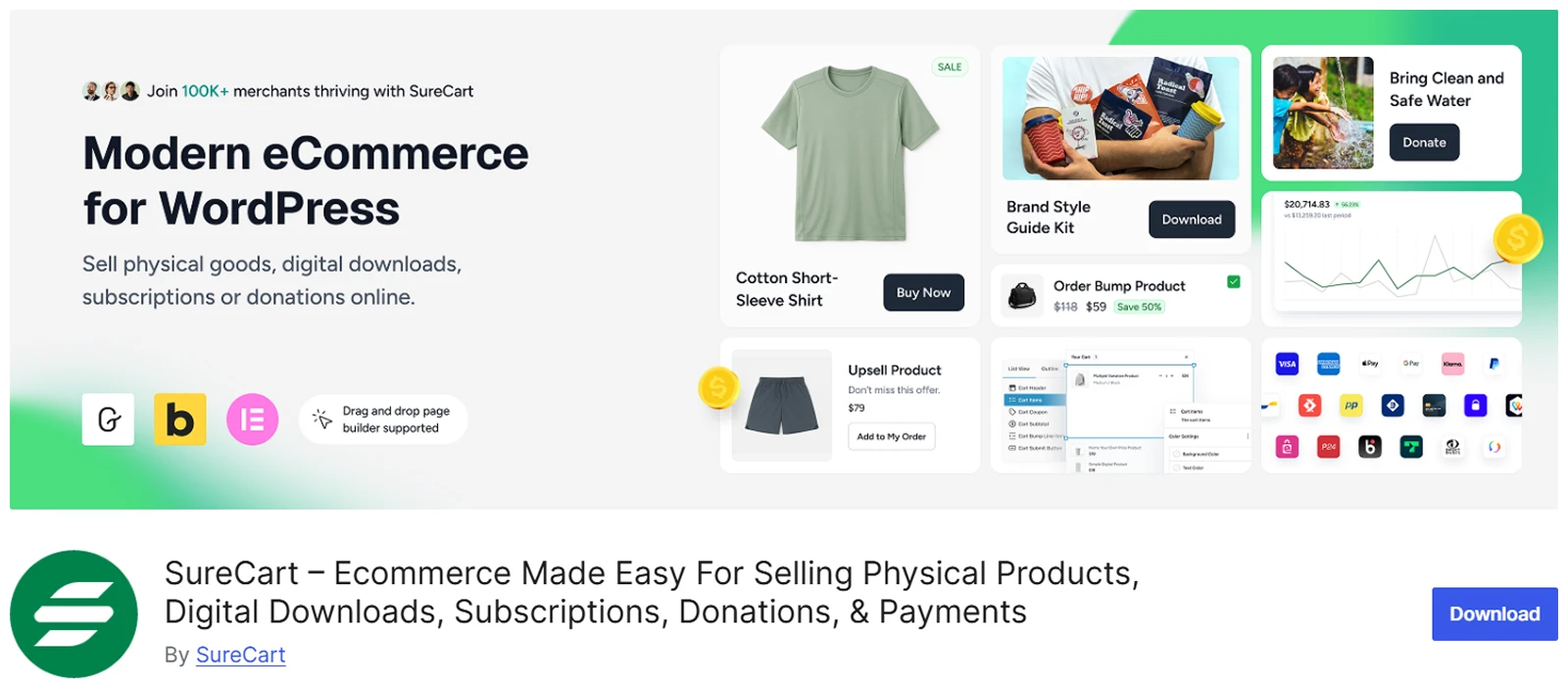
Similar to WooCommerce, SureCart is also a complete WordPress eCommerce plugin. This one also lets you sell physical products, digital downloads, subscriptions, services, payment plans, and more.
But its biggest advantage is its cloud-powered backend. SureCart runs its eCommerce engine on its own cloud system while your WordPress site handles the storefront and design.
That means many core eCommerce processes run outside your WordPress server, which will reduce the workload on your site.
However, the cloud architecture also means less control, dependence on SureCart’s platform, and low-level customization options than a fully self-hosted plugin.
Key Features:
- Sells physical products, digital downloads, subscriptions, and services
- Built-in subscription and recurring billing management
- Order bumps, upsells, and abandoned cart recovery
- Automatic tax calculation
- Inventory tracking and fulfillment management
- Easy migration from WooCommerce and other platforms
What We Like Most:
- Fast checkout since processing happens off-server
- Easier setup than many traditional store plugins
- Strong built-in subscription and revenue features
What Could Be Better:
- +2.9% transaction fee in the free plan
- Cloud-powered model may not suit users wanting full self-hosting
- Smaller ecosystem than WooCommerce
Pricing
SureCart has a free Launch plan with a 2.9% transaction fee. And the pro plan starts at $179/year for one store. Lifetime options are also available that start from $599 for a single store.
3. Easy Digital Downloads (EDD) - Best for Digital Products and Software Licensing
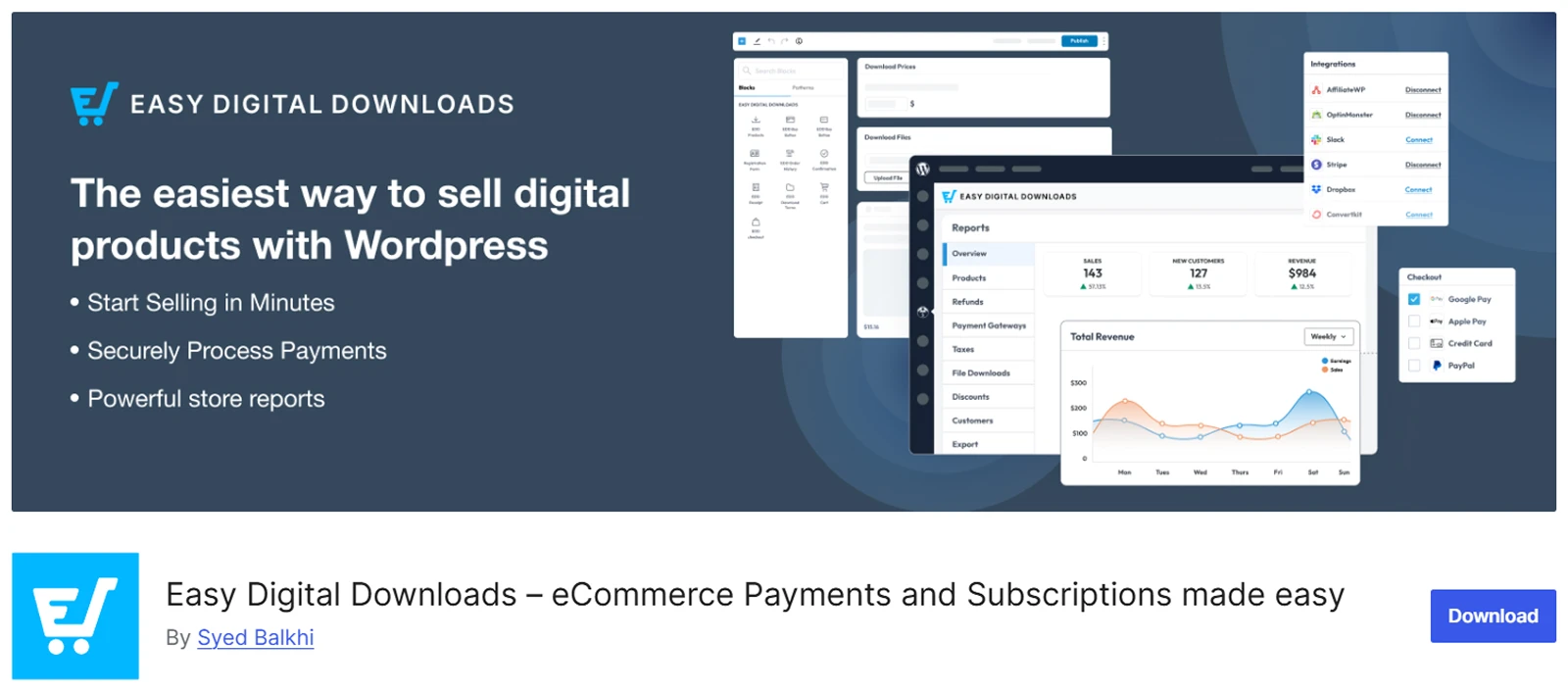
As the name suggests, Easy Digital Downloads is focused on digital products. Unlike general plugins like WooCommerce and SureCart, this one is built specifically for selling digital products like software, eBooks, and templates.
Although you can also sell physical products with EDD, for that you will need additional extensions.
While selling digital products, you will get built-in tools for file delivery, download tracking, customer management, discount codes, payment collection, and order records.
For more advanced needs like software licensing, recurring payments, memberships, email marketing, and advanced reporting, you can extend EDD with its official add-ons.
Key Features:
- Software licensing system with automatic update delivery
- Secure file delivery with download limits and expiring links
- Unlimited products and transactions on the free plan
- Discount codes with percentage, flat-rate, and usage-limit options
- Detailed sales reporting by product, date range, and category
- Subscriptions and recurring payments through extensions
- Works well for product libraries, memberships, and creators.
What We Like Most:
- Excellent fit for digital products and software businesses.
- Strong license key and software delivery support
- Reliable download protection and access control
- Self-hosted setup with full data control.
What Could Be Better:
- Not ideal for physical products or complex inventory
- Recurring payments require a separate add-on
- Can get costly as you add more extensions
Pricing
EDD has a free version and paid plans start from $99.50/year. You will also find plans for 2 and 3 websites.
4. FluentCart - Best for Performance-Focused WordPress Stores
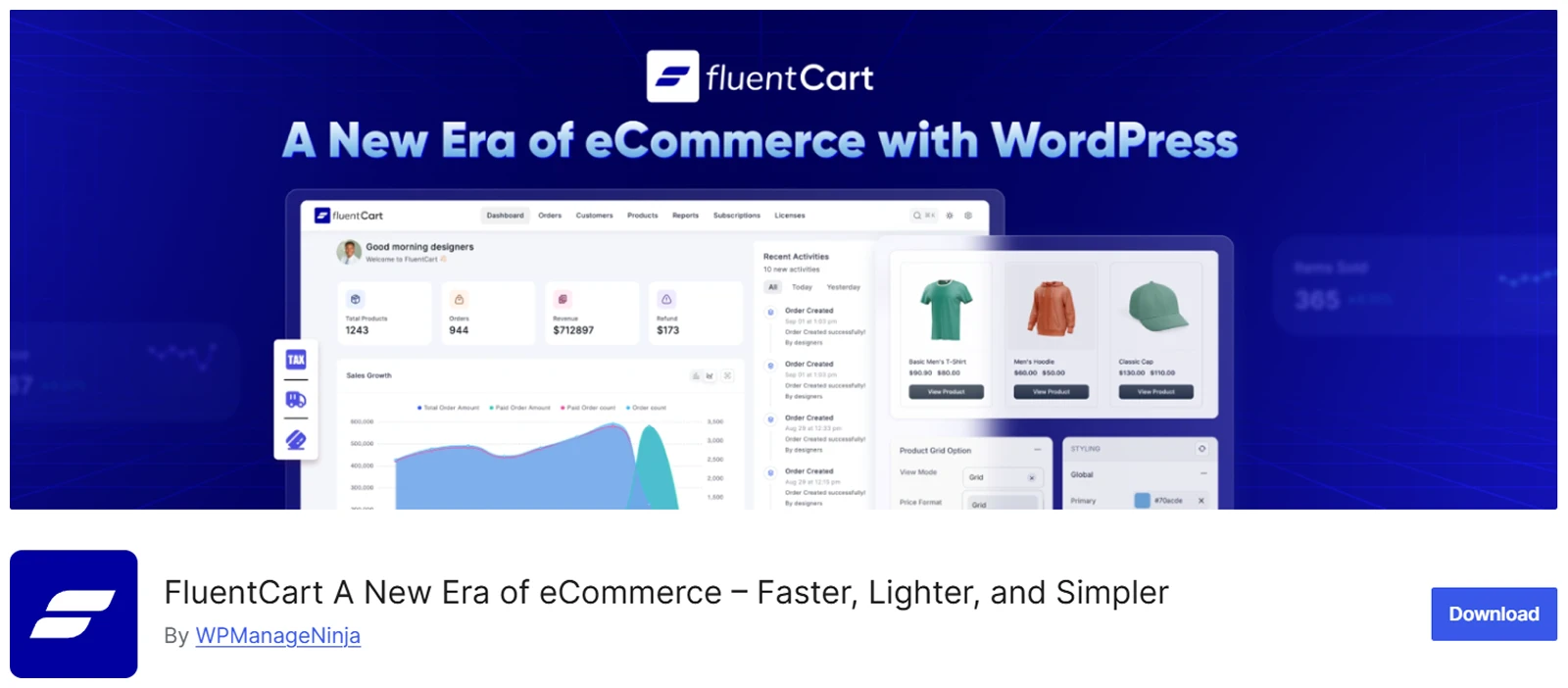
Like WooCommerce and SureCart, FluentCart is a full-featured eCommerce plugin. This one lets you sell physical, digital, hybrid, subscription, and licensed products from a single platform.
In short, you can create and manage almost any type of online store with FluentCart. However, one thing that makes FluentCart stand out is its performance-first approach.
Instead of using the standard WordPress database structure, FluentCart uses custom database tables to store and manage eCommerce data such as products, orders, customers, subscriptions, and checkout records.
Besides that, FluentCart includes built-in tools for checkout, inventory, subscriptions, licensing, analytics, marketing, and customer management.
Key Features:
- Built-in subscription and recurring billing
- Native software licensing for plugin, theme, and SaaS sellers
- Gutenberg blocks and Elementor widgets for checkout and product pages
- Role-based team access for order fulfillment and support staff
- Headless-ready with a full REST API for custom storefronts
What We Like Most:
- Performance-first WordPress eCommerce approach
- Self-hosted with full ownership of data
- Good feature set without stacking many plugins
- Business-grade analytic tool
What Could Be Better:
- Limited advanced features for complex physical stores, like product weight, dimensions, and shipping calculations.
- No built-in product reviews or ratings, requiring third-party plugins.
- Premium plans can be expensive for beginners or small businesses.
Pricing
FluentCart offers a free version with essential eCommerce functionality. Premium plans provide additional features that start from $199/year or $249/lifetime for a single site.
5. Ecwid - Best for Multi‑Channel & Cross‑Platform Selling

Ecwid is a hosted eCommerce plugin for WordPress. This one lets you add a full online store to your website and sell across channels like Facebook, Instagram, Amazon, eBay, and more.
That means you can manage products in Ecwid and display/sell them across multiple channels, not just your WordPress site. In terms of product type, you can sell physical products, digital downloads, and services.
Since Ecwid is a hosted solution, most store tasks like adding products, managing inventory, handling checkout, and processing orders happen inside your Ecwid account. And your site will act as a display window for your store.
However, you get less control inside WordPress compared to self-hosted plugins, like database ownership, template customization, and more.
Key Features:
- One product catalog synced across your website and social networks
- Mobile POS app for in-person sales at markets or pop-ups
- Automatic tax calculation and multi-currency support
- 30+ payment gateways, including Stripe, PayPal, and Square
- Abandoned cart recovery on paid plans
What We Like Most:
- Great for multi-channel selling
- Faster setup than many self-hosted options
- Store management is not fully dependent on WordPress
- Good for small businesses and social sellers
What Could Be Better:
- Less WordPress-native than WooCommerce
- Lower plans have product limits, like starter only lets you add 10 products
Pricing
Ecwid starts at $5/month for the Starter plan. Higher plans add more products, e-goods, social selling, subscriptions, staff accounts, and advanced reports that can go up to $149 per month. It also has plans for unlimited websites.
6. WordPress Download Manager - Best for Secure File Sales & Access Control
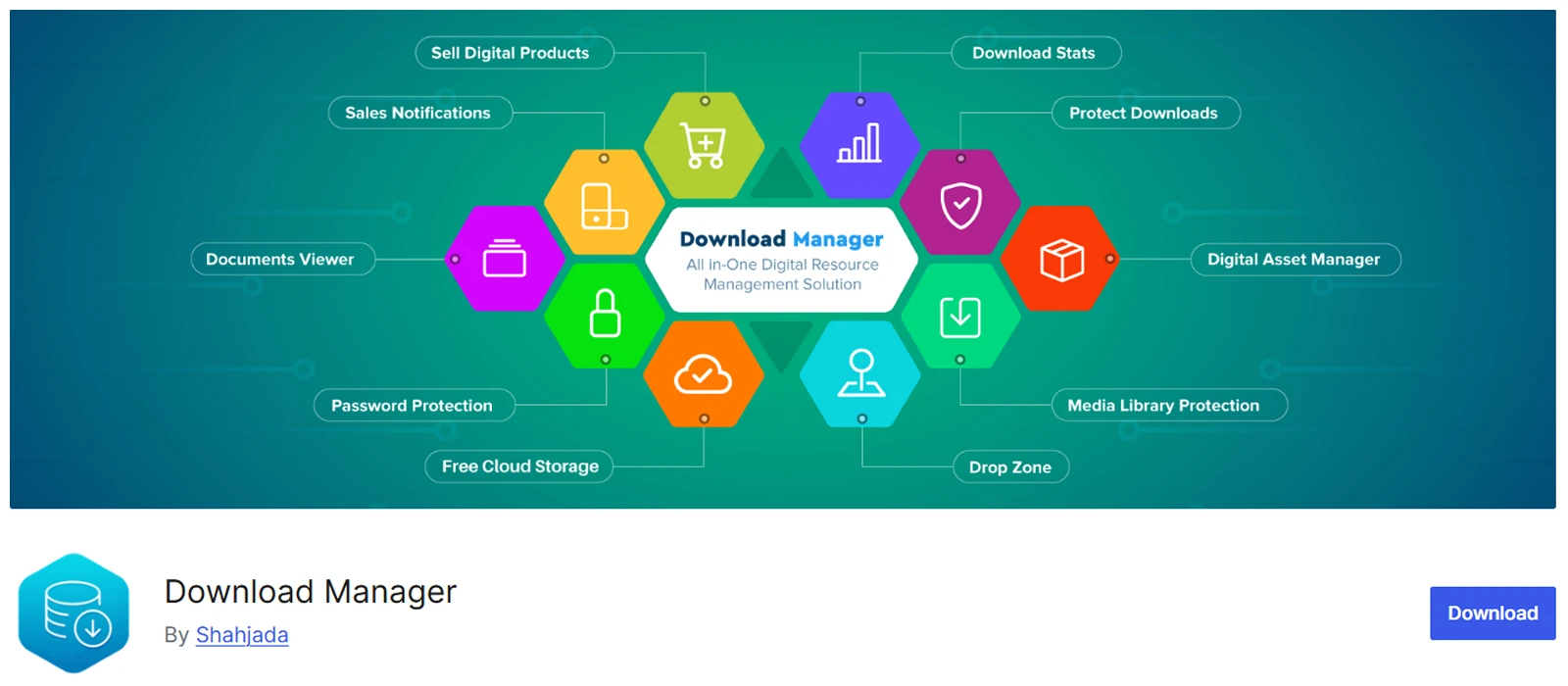
Like Ecwid, WordPress Download Manager is not a traditional all-purpose eCommerce plugin. Instead, it focuses on selling, protecting, and managing downloadable files from your WordPress site.
You can use this plugin to manage and sell digital assets like eBooks, PDFs, software, templates, plugins, themes, music, videos, documents, and other files users can access after purchase.
To manage these files, it includes features like access control, download limits, password protection, file organization, and secure delivery. For selling, it lets you accept payments, manage orders, generate invoices, and deliver purchased files automatically.
So if anyone wants to sell digital files with proper protection and access control, WordPress Download Manager can be a practical choice.
Key Features:
- Password, CAPTCHA, IP-block, and hotlink protection for every file
- Optional built-in shopping cart for selling files without WooCommerce
- Email-lock gating that captures leads before granting a download
- Cloud storage integration with Amazon S3, Google Drive, and Dropbox
- Download tracking and analytics by user, file, and date
- Software license key generation for selling plugins or themes
What We Like Most:
- Strong for protected file delivery
- Useful for software, PDFs, and document selling
- Good access control and download tracking
- Over 80 add-ons let you extend it the capabilities
What Could Be Better:
- Not suitable for full physical stores
- Store design flexibility may feel limited for general eCommerce
Pricing
WordPress Download Manager has a free version. Its pro plans are starting around $99/year for advanced features. You will also find plans for 5 and up to 48 websites.
7. WP EasyCart - Best for Simple and Small Businesses
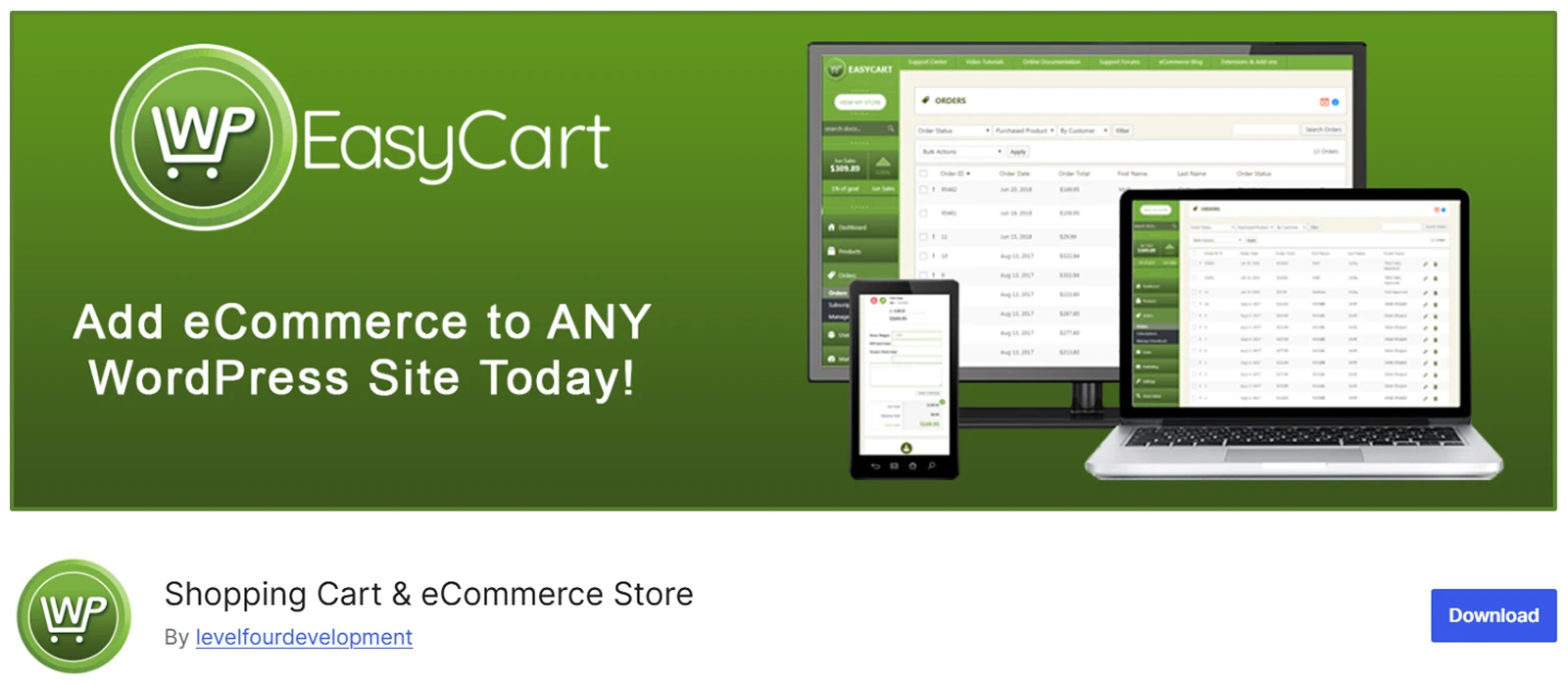
WP EasyCart is a WordPress shopping cart plugin for beginners and small businesses. It lets you sell physical products, digital downloads, services, subscriptions, memberships, donations, gift cards, and more from one dashboard.
You also get tools for payments, shipping, taxes, coupons, promotions, abandoned cart automation, inventory, and order fulfillment, which makes it an all-in-one store solution for anyone.
Its biggest strength is reducing the need for extra plugins for basic store needs. However, the free version adds a 2% transaction fee. And also its design experience can feel less modern than newer block-first eCommerce plugins.
Key Features:
- Retail, digital, subscription, donation, and service-based products
- Built-in Stripe, Square, and PayPal Express carts
- 30+ SCA- and GDPR-compliant payment options
- Live shipping rate calculators and order editing tools
- Apple Pay, Google Pay, and Microsoft Pay support on paid tiers
- Native Facebook and Instagram selling on the Premium tier
What We Like Most:
- Good for small business stores
- Supports many product and payment types
- Does not require many extra plugins for basic needs
What Could Be Better:
- Interface may feel less modern
- Free plan carries a 2% transaction fee on top of gateway fees
- Steeper learning curve due to the sheer number of built-in options
Pricing
WP EasyCart has a free version. You can also use its pro plans that start from $69/year.
8. StoreEngine - Best for Built-In Business Features
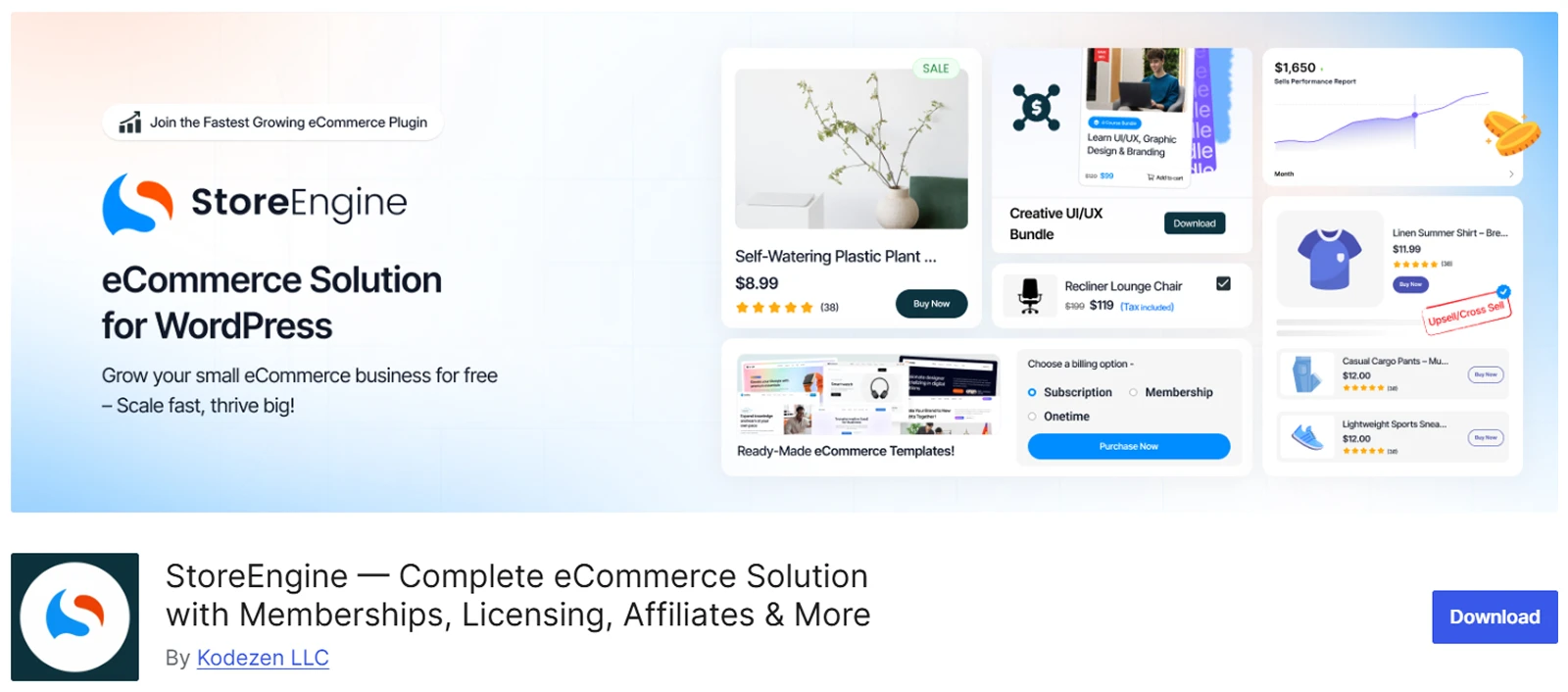
StoreEngine is relatably new WordPress eCommerce plugin designed to sell any type of product without relying on multiple add-ons. It supports physical products, digital downloads, subscriptions, memberships, services, donations, licenses, bundles, etc.
Beyond the essentials, StoreEngine includes built-in tools for license management, secure file delivery, affiliate tracking, upsells, cross-sells, analytics, and email notifications. It also provides Gutenberg blocks to build and customize your store.
Additionally, StoreEngine supports multi-vendor marketplaces, catalog mode, multi-currency selling, and store migration. All these features make StoreEngine a versatile eCommerce solution.
Key Features:
- Easy product management for physical and digital items
- Subscriptions, memberships, and access control
- Built-in affiliate system with referral tracking and payout management
- Native support for physical products, digital downloads, and services
- Gutenberg-native checkout, cart, and product blocks
- Built-in upsells, cross-sells, coupons, and an analytics dashboard
What We Like Most:
- Clean and user-friendly interface
- Fast setup with minimal configuration
- Suitable for both beginners and growing businesses
- Focus on performance and simplicity
What Could Be Better:
- Still evolving compared to older plugins
- Fewer third-party extensions than established platforms
- Advanced features may require future updates
Pricing
StoreEngine offers a free version with essential features. Its premium version starts from $99/y and $319/lifetime for a single site. StoreEngine has pricing plans for 10, 25, and up to 100 sites.
9. WP Sell Services - Best for Service Marketplaces and Gigs
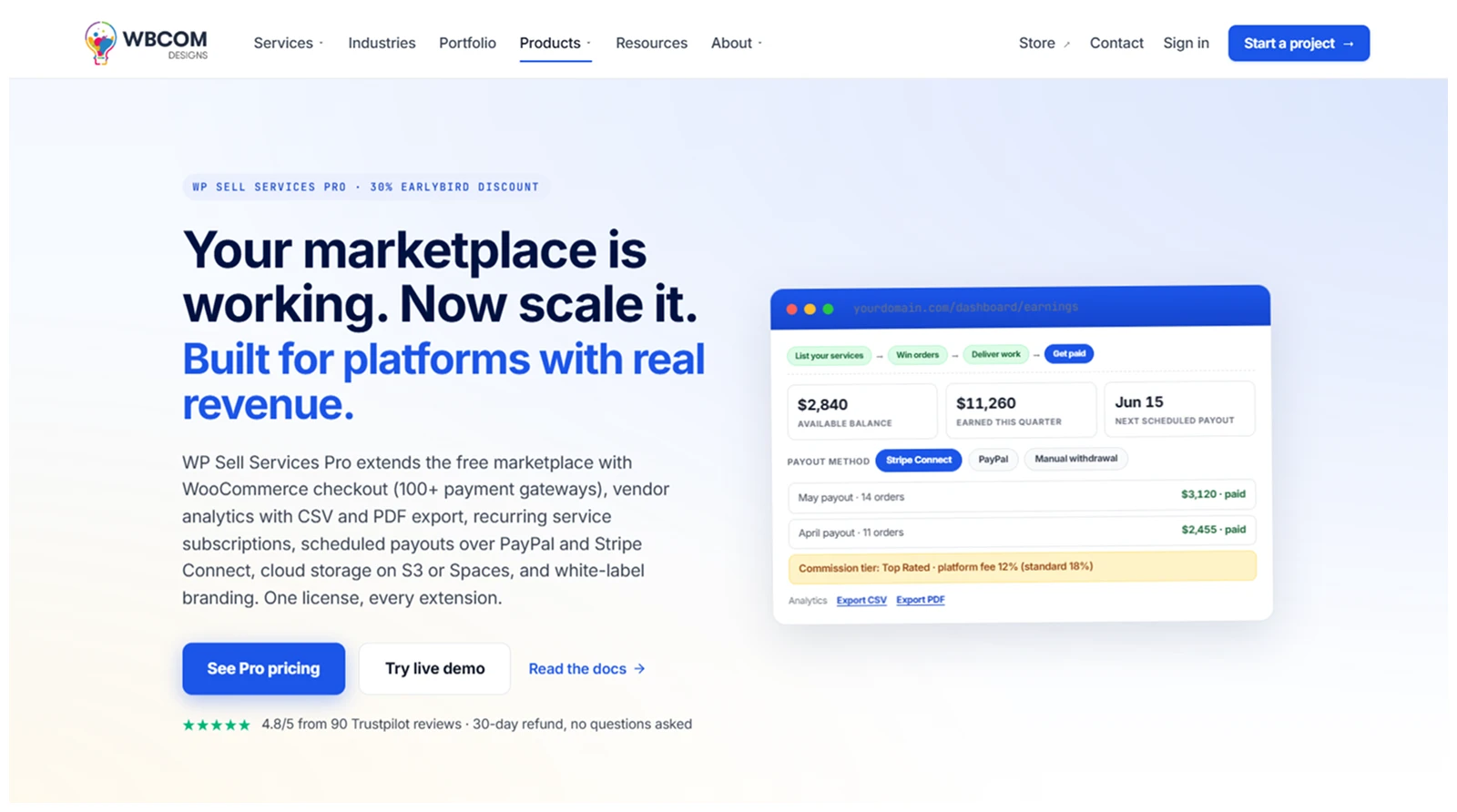
As its name suggests, WP Sell Services is a service marketplace plugin for WordPress. With this, you can create a Fiverr-style marketplace where vendors list services with packages, or an Upwork-style marketplace where buyers post requests and vendors send proposals.
To make the service-selling process easier, it includes vendor dashboards, service listings, order management, buyer-seller communication, reviews, disputes, and commission settings.
WP Sell Services also supports both single-vendor and multi-vendor service selling. That means, it’s useful for both individual service sellers and marketplace owners who want multiple vendors to sell services from one site.
Key Features:
- Fiverr-style service catalog
- Upwork-style buyer request system
- Vendor dashboard and service wizard
- Built-in Stripe, PayPal, and offline checkout
- Order workflow with requirements, delivery, and revisions
- Reviews, disputes, commissions, blocks, and shortcodes
What We Like Most:
- Built specifically for service workflows
- Supports both catalog and request-based marketplaces
- Does not require WooCommerce for core checkout
- Free version includes strong marketplace features
What Could Be Better:
- Not useful for normal product stores
- Best only for service-selling business models
- Advanced payout, analytics, and white-label features need Pro
Pricing
WP Sell Services has a free version. And Pro starts at $69/year and $199/lifetime for one site. There are also plans for 5 and unlimited websites.
10. EasyCommerce - Best for AI-Assisted Store Management
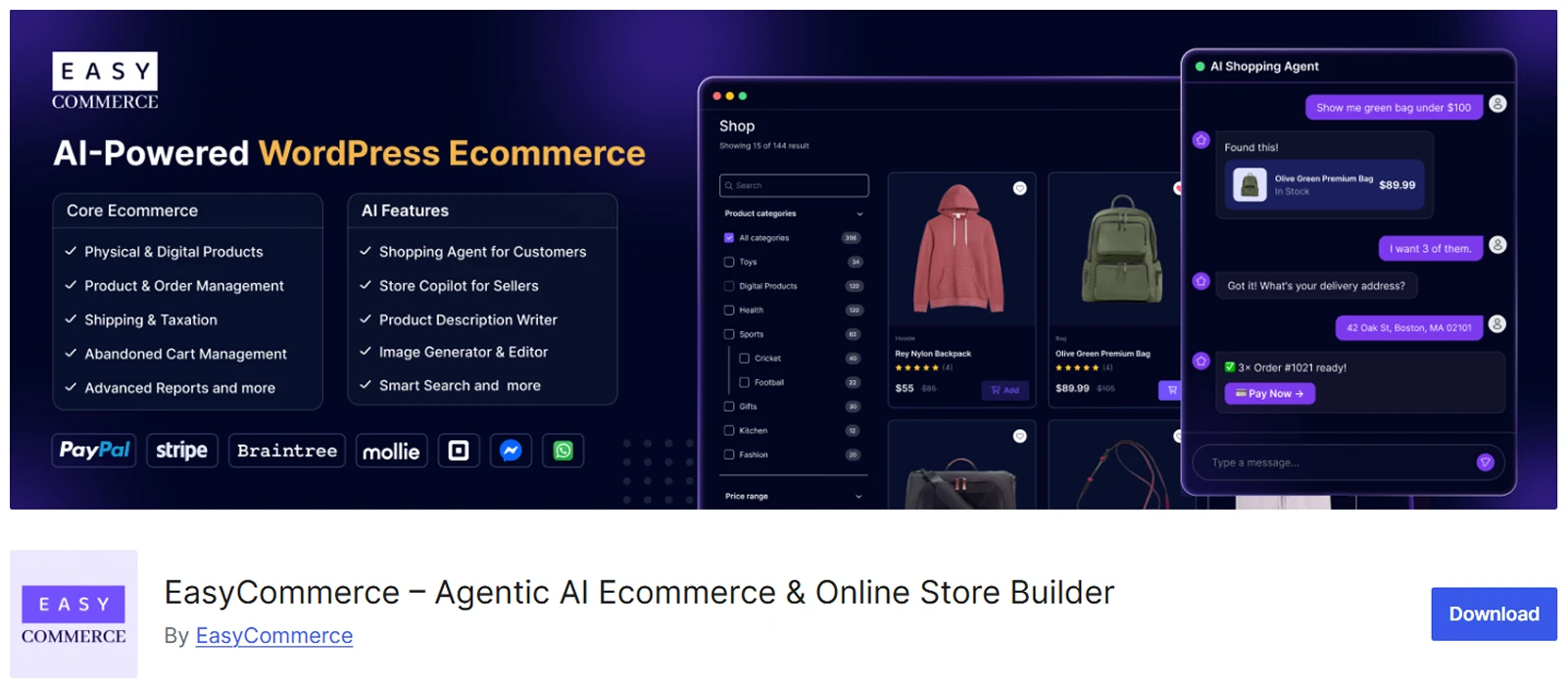
EasyCommerce is a newer WordPress eCommerce plugin. Its biggest highlight is the built-in AI layer, which helps with store setup, product copy, smart search, template generation, image creation, and customer shopping assistance.
Beyond its AI capabilities, EasyCommerce includes the core features needed to run a complete online store. It supports physical, digital, hybrid, subscription, and licensed products, along with product variations, checkout, payments, taxes, and more.
Since its ecosystem is still growing, it may not feel as mature as some established alternatives. However, if you want AI-powered tools to simplify store management and improve the shopping experience, EasyCommerce is worth trying.
Key Features:
- Product variations, checkout, payments, and orders
- AI Shopping Agent that chats with customers and completes purchases automatically
- AI Store Copilot in the admin dashboard for stock updates and refunds via chat
- Dedicated database tables for faster performance at scale
- Native support for selling physical and digital products from one listing
- AI-generated product descriptions and marketing copy
- Real-time sales dashboard with abandoned cart recovery
What We Like Most:
- Strong AI-assisted store building concept
- Free core plugin with important selling features
- Good fit for modern small to medium stores
- Supports product content, search, and customer help with AI
What Could Be Better:
- Newer and less proven than older plugins
- Some advanced features are still evolving
- AI credits and add-ons may add extra costs
Pricing
EasyCommerce core is free with zero transaction fees. And it comes with both annual and lifetime plans for 1, 10 and 100 websites. Its single site plan cost $199/year and $499/lifetime.
How to Choose the Best WordPress Plugins for eCommerce
When choosing an ecommerce plugins WordPress, there are certain things that you must keep in mind, such as:
- Store Type: Decide what you want to sell. Physical products need shipping, taxes, and inventory, while digital products need secure file delivery. For services, memberships, or marketplaces, choose a plugin built for that specific model.
- Platform Type: Check whether the plugin is self-hosted, cloud-powered, or SaaS-based. Self-hosted plugins give you more WordPress-side control, while cloud or SaaS tools can make setup easier and reduce server load.
- Payment Options: Make sure the plugin supports your preferred payment methods, such as Stripe, PayPal, local gateways, recurring payments, or offline payments.
- Tax and Shipping: If you sell physical products, tax and shipping features are important. Look for shipping zones, live rates, tax rules, VAT support, and location-based tax calculation.
- Builder Compatibility: If you use a page builder like Divi or Elementor, check whether the plugin gives you enough control over shop pages, product layouts, cart, and checkout design.
- Scalability and Cost: Don’t choose based on the free version only. Check how much it costs when you add subscriptions, shipping, licensing, extra gateways, or other advanced features.
FAQ
- What Is a WordPress eCommerce Plugin?
A WordPress eCommerce plugin adds online store features to your website, such as products, payments, checkout, orders, shipping, taxes, and customer management. With all these, you can be able to create an ecommerce on WordPress.
- What is the best free ecommerce plugin for WordPress?
When it comes to WordPress free ecommerce plugins, WooCommerce should be your first choice. In fact, some of the best ecommerce websites are even built with Woo, though some use extra plugins and extensions for that.
- Can WooCommerce create a multi-vendor marketplace?
WooCommerce can support a multi vendor through a multi vendor eCommerce WordPress plugin. You can use a Woo plugin like Dokan to add multi-vendor features as WooCommerce doesn't include multi-vendor functionality by default.
- What are the must have WordPress plugins for ecommerce?
Must-have ecommerce plugin WordPress can be categorized based on your store's needs. But most stores need plugins for SEO, security, backups, marketing, and analytics.
- Are WordPress ecommerce plugins safe?
Yes, WordPress eCommerce plugins are safe if you use trusted plugins, update them regularly, enable SSL, and use secure payment gateways.
- How to add ecommerce plugin to WordPress?
Go to your WordPress dashboard, then Plugins > Add New. Search for the eCommerce plugin you want, then install it, activate it, and follow the setup wizard. If you are using a premium plugin, first download the ZIP file from the provider’s website, then upload it through Plugins > Add New > Upload Plugin.
- What are the differences between ecommerce and woocommerce?
eCommerce means selling products or services online. WooCommerce is a WordPress plugin that helps you build and manage an eCommerce store.
Final Thoughts: Which Plugin to Choose to Create WordPress ecommerce Website?
The best WordPress eCommerce plugin ultimately depends on your business needs. If you want maximum flexibility and room to grow, WooCommerce is still the top choice.
If you prefer a faster, lighter setup with less server load, SureCart and FluentCart are excellent alternatives. If you sell digital products or software, Easy Digital Downloads and WordPress Download Manager are purpose-built options.
If you plan to sell across social media and online marketplaces, Ecwid is worth considering. Service-based businesses will benefit from WP Sell Services, while StoreEngine and WP EasyCart are great options for beginners.
Ultimately, there is no one-size-fits-all solution as the best choice is the plugin that fits your store.


0 Comments