


WordPress still dominates the web. It powers 41.2% of all websites worldwide. Among websites using a CMS, it holds 59.1% of the market.
That's an impressive lead. But the market is changing.
WordPress's market share dropped by 1.9% over the past year, while others like Shopify and Wix are continuing to grow.
Yet WordPress keeps changing fast. AI features are expanding across the platform and block-based editing keeps improving as well.
So, where does WordPress stand today?
We gathered the latest numbers to answer that question. This guide covers market share, website usage, WordPress versions, plugins, themes, page builders, WooCommerce, security, and more.
No fluff. Just the latest WordPress statistics to help WordPress users understand what the numbers mean.
Let's dive in.
We used trusted sources such as W3Techs, BuiltWith, WordPress.org and more. Since each source tracks data differently, we reviewed the figures carefully and avoided comparing numbers that measure different things.
Key WordPress Statistics for 2026
- WordPress powers 41.2% of all websites. (W3Techs)
- WordPress holds 59.1% of the known CMS market. (W3Techs)
- BuiltWith detects 37,998,485 live WordPress websites. (BuiltWith)
- WordPress 7 powers 52.3% of WordPress websites. (W3Techs)
- WordPress.org offers more than 68,000 free plugins. (WordPress Plugin Directory)
- WordPress.org offers more than 14,000 free themes. (WordPress Theme Directory)
- WooCommerce is detected on 19.8% of WordPress websites. (W3Techs)
- WooCommerce is used by 8.2% of all websites. (W3Techs)
- BuiltWith detects Divi on more than 2.29 million live websites. (BuiltWith)
- Wordfence added 2,738 vulnerabilities to its database during Q1 2026. (Wordfence)
WordPress Market Share Statistics
1. WordPress powers 41.2% of all websites
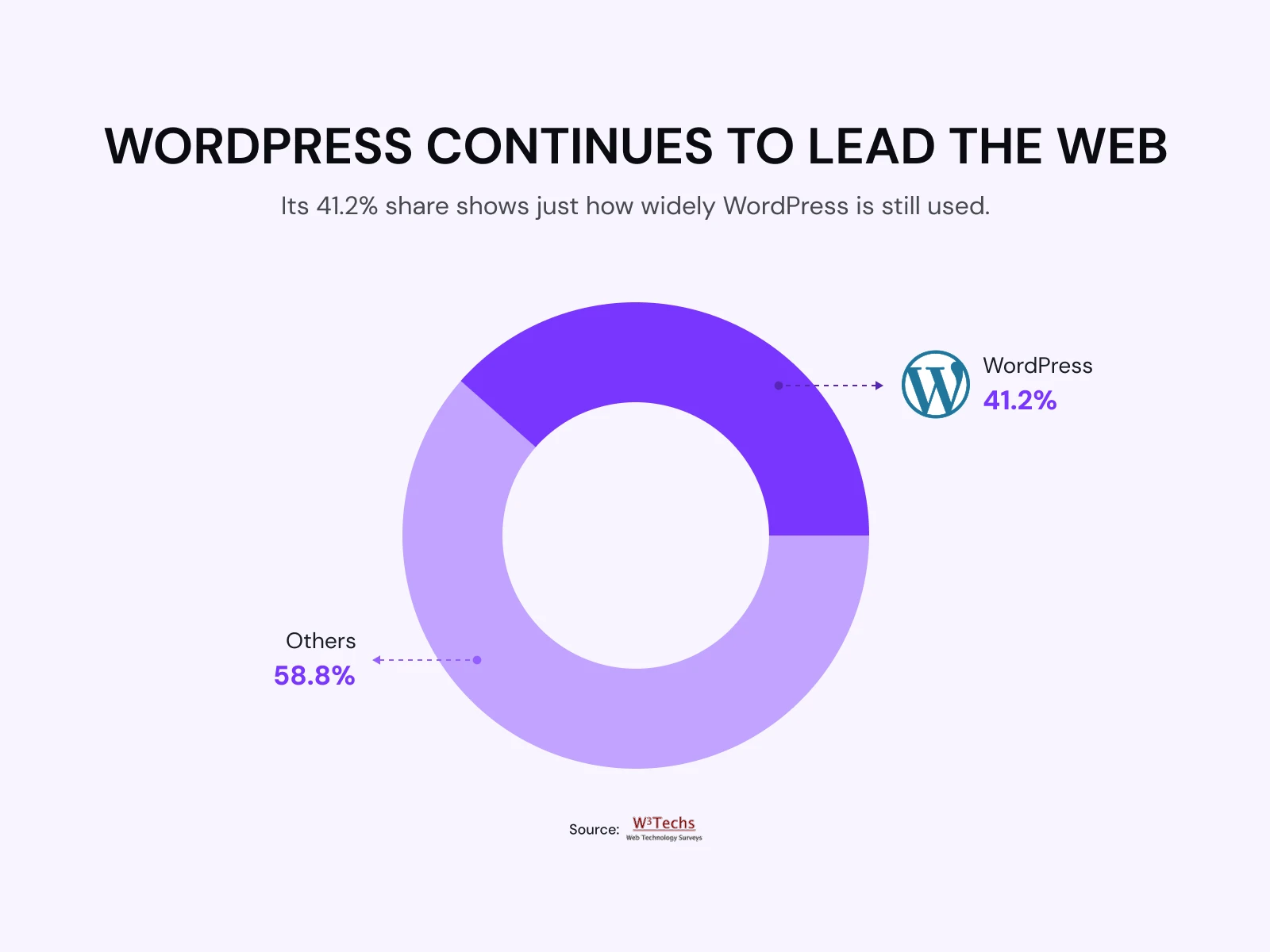
More than four out of every ten websites tracked by W3Techs use WordPress. (W3Techs)
2. WordPress holds 59.1% of the known CMS market
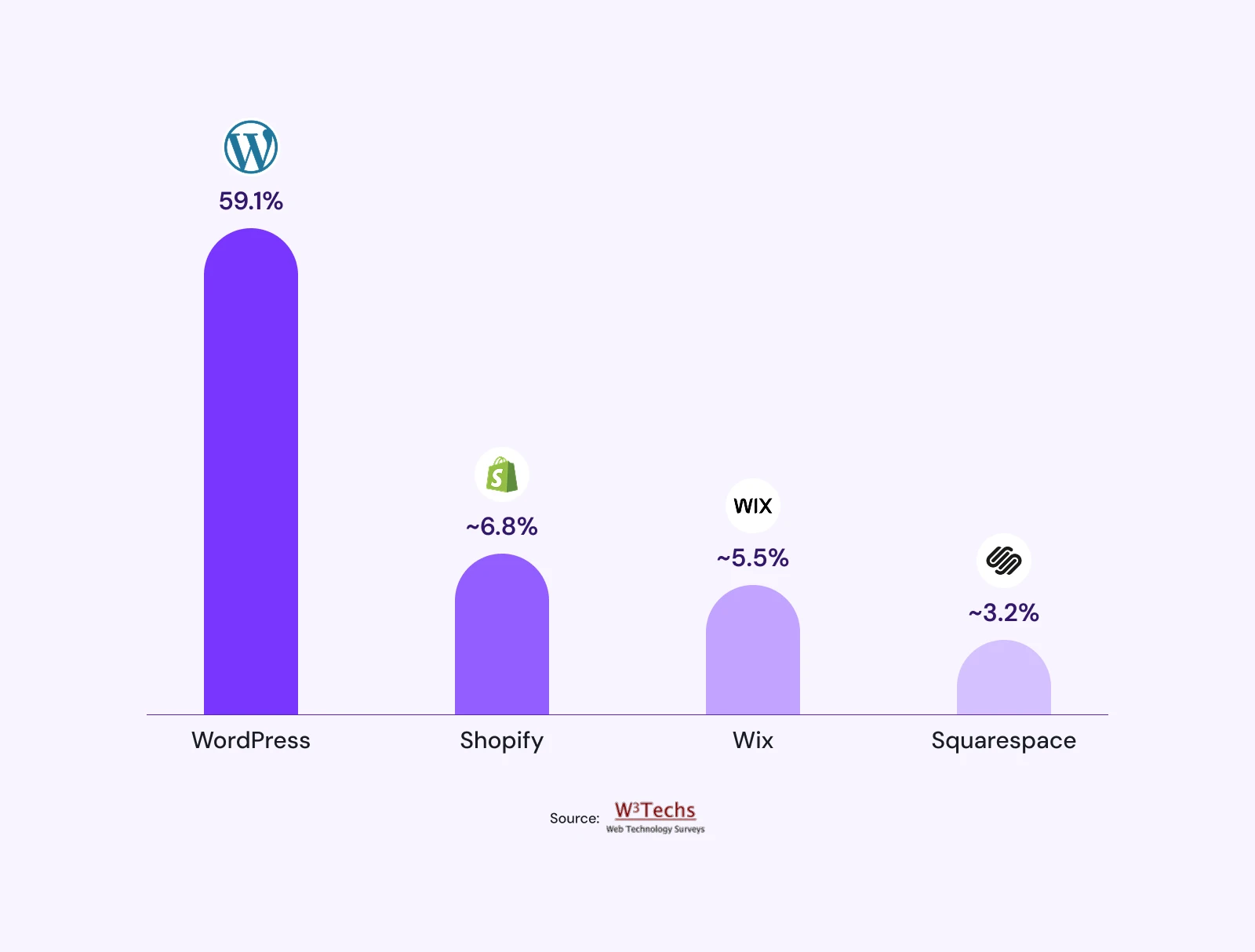
Among websites whose content management system can be identified, 59.1% use WordPress. (W3Techs)
3. WordPress’s CMS share declined from 61% to 59.1%
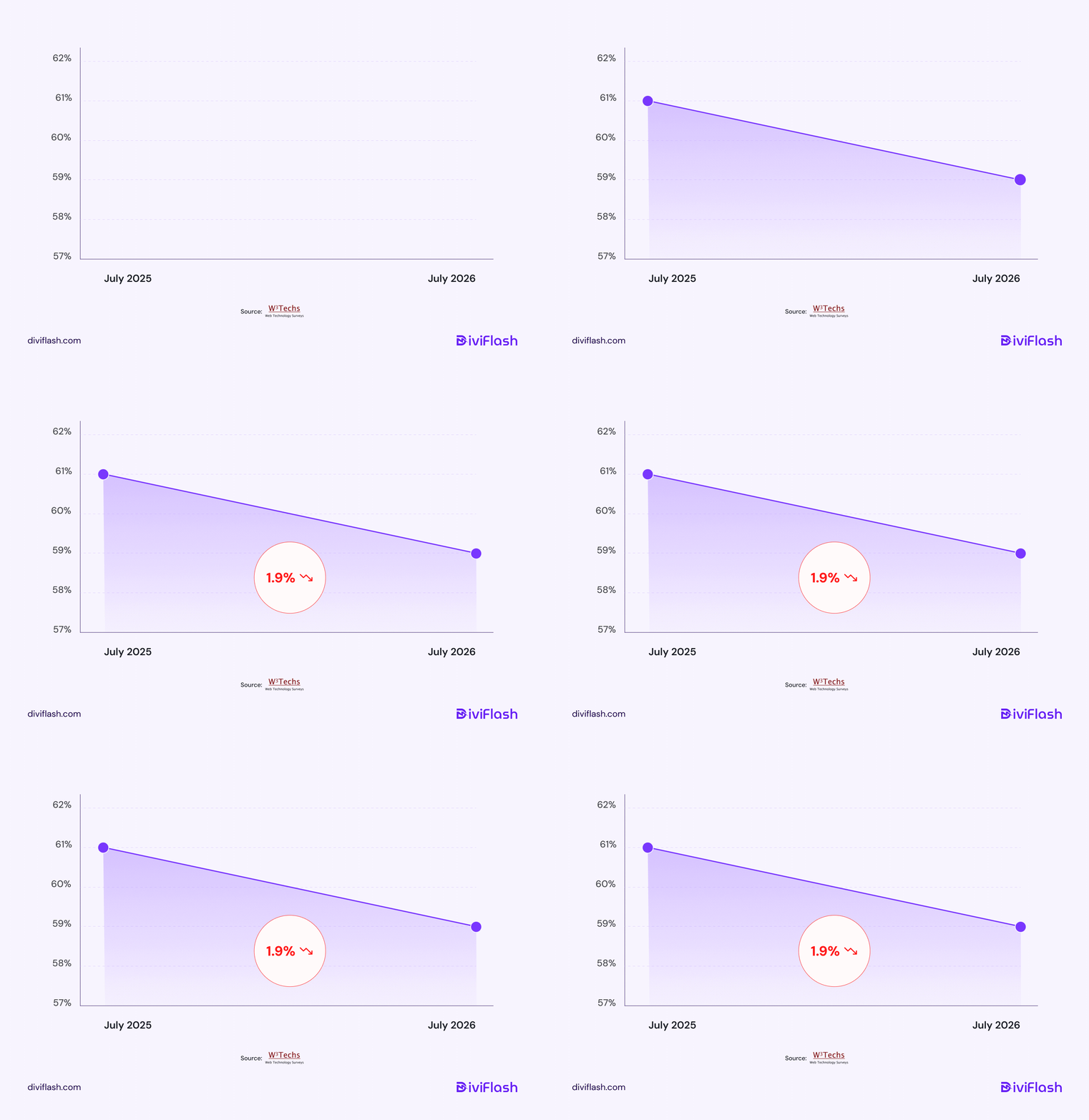
WordPress held 61% of the known CMS market in July 2025. Its share had decreased to 59.1% by July 27, 2026. (W3Techs)
4. WordPress’s CMS share is nearly eight times larger than Shopify’s
Shopify holds 7.6% of the known CMS market. In comparison, WordPress holds 59.1%. (W3Techs)
WordPress Website Usage Statistics
5. BuiltWith detects 37,998,485 live WordPress websites
This is the number of currently active sites detected by BuiltWith’s technology scanner. (BuiltWith)
6. More than 85 million websites have used WordPress
BuiltWith has identified 85,225,560 current and historical WordPress websites. (BuiltWith)
7. More than 2.38 million domains redirect to live WordPress websites
BuiltWith identifies 2,385,623 website redirects connected with detected WordPress sites. (BuiltWith)
8. More than 306,000 top-one-million websites use WordPress
BuiltWith detects WordPress on 306,841 websites among the world’s top one million sites by traffic. (BuiltWith)
9. More than 19,000 top-100,000 websites use WordPress
WordPress is detected on 19,284 websites in BuiltWith’s top-100,000 category. (BuiltWith)
10. More than 1,800 top-10,000 websites use WordPress
BuiltWith detects WordPress on 1,861 of the top 10,000 websites. (BuiltWith)
11. WordPress is detected on 217 top-1,000 websites
This demonstrates that WordPress is used by high-traffic properties as well as smaller websites. (BuiltWith)
WordPress Growth Statistics
12. AI is becoming part of WordPress

WordPress 7.0 introduced a built-in AI Client. The AI Client gives plugin developers a standard way to connect WordPress with different AI providers and services. (Make WordPress Core)
13. Block-based website building is expanding
Block themes are becoming more important because they let users customize headers, footers, templates, and other website areas through the Site Editor. (WordPress Block Themes Documentation)
14. Visual page builders remain popular
Visual builders remain popular within WordPress. Elementor is currently used by approximately 31.5% of websites running WordPress. (W3Techs)
15. Responsive editing is improving
WordPress is adding more device-specific controls, including block visibility and styling options for desktop, tablet, and mobile screens. (Make WordPress Core)
16. Headless WordPress
Headless WordPress is becoming more established. Developers are increasingly using WordPress as a content backend for websites built with frameworks such as React and Next.js. (WPGraphQL on WordPress.org)
17. Patterns and design systems are growing
WordPress patterns make reusable website design easier. Patterns, global styles, presets, and theme.json help designers create consistent layouts across multiple pages and websites. (WordPress Pattern Editing)
WordPress Usage Statistics by Country
18. The United States has more than 17 million WordPress websites
BuiltWith detects 17,070,646 live WordPress sites in the United States. (BuiltWith)
19. Germany has more than 1.94 million WordPress websites
Germany has the second-highest detected WordPress total. (BuiltWith)
20. The United Kingdom has more than 1.41 million WordPress websites
BuiltWith detects 1,412,923 live WordPress websites in the United Kingdom. (BuiltWith)
21. Brazil has more than one million WordPress websites
BuiltWith detects 1,023,886 live WordPress sites in Brazil. (BuiltWith)
22. France has more than one million WordPress websites
BuiltWith identifies 1,020,153 live WordPress sites in France. (BuiltWith)
23. Italy has more than 973,000 WordPress websites
Italy is one of the largest European WordPress markets. (BuiltWith)
24. The Netherlands has more than 905,000 WordPress websites
The Netherlands has a high number of detected WordPress sites relative to its population. (BuiltWith)
25. India has more than 745,000 WordPress websites
BuiltWith detects 745,903 live WordPress sites in India. (BuiltWith)
WordPress Version Statistics
26. WordPress 7 powers 52.3% of WordPress websites
More than half of all detected WordPress websites now use a version from the WordPress 7 release series. (W3Techs)
27. WordPress 6 powers 40.4% of WordPress websites
WordPress 6 remains the second-most widely used major version. (W3Techs)
28. WordPress 5 remains on 5.1% of WordPress websites
Around one in every 20 WordPress websites still uses a WordPress 5 release. (W3Techs)
29. WordPress 4 remains on 2.1% of WordPress websites
A small but notable percentage of websites continue to use WordPress 4. (W3Techs)
30. WordPress 3 remains on 0.2% of WordPress websites
Some websites continue to run software from the WordPress 3 release series. (W3Techs)
Note: You can check the installed version from the WordPress admin area under Dashboard > Updates.
WordPress Plugin Statistics

31. WordPress.org offers more than 68,000 free plugins
The official Plugin Directory is the largest source of free and open-source WordPress plugins. (WordPress Plugin Directory.)
32. Plugin submissions reached approximately 700 per week
The Plugins Team recorded around 700 weekly submissions during May 2026. (Plugins Team Status Update)
33. Nearly 3,000 plugin submissions were reviewed in May 2026
The WordPress Plugins Team checked almost 3,000 submitted plugins during the month. (Plugins Team Status Update)
34. Elementor has more than 10 million active installations
Elementor is one of the most widely installed plugins in the WordPress directory. (WordPress.org)
35. Yoast SEO has more than 10 million active installations
Yoast SEO has also passed the 10-million active-installation mark. (WordPress.org.)
36. Classic Editor has more than nine million active installations
Millions of website owners continue to use the Classic Editor instead of the Block Editor. (WordPress.org)
37. WooCommerce has more than seven million active installations
WooCommerce remains the most widely installed ecommerce plugin in the WordPress directory. (WordPress.org)
WordPress Page Builder Statistics
38. Elementor is used by 31.5% of WordPress websites
Elementor is the most widely detected WordPress subtechnology in W3Techs’ survey. (W3Techs)
39. WPBakery is used by 7.5% of WordPress websites
WPBakery remains widely used despite losing share to newer building tools. (W3Techs)
40. Beaver Builder is used by 1% of WordPress websites
Beaver Builder has a much smaller share than Elementor and WPBakery. (W3Techs)
41. Oxygen is used by 0.4% of WordPress websites
Oxygen remains a niche WordPress website-building solution. (W3Techs)
42. Bricks is used by 0.3% of WordPress websites
Bricks has a smaller market presence but continues to attract designers and developers. (W3Techs)
WordPress Theme Usage Statistics
43. WordPress.org offers more than 14,000 free themes
The official directory contains classic themes, block themes, community themes, and themes with commercial upgrades. (WordPress Theme Directory)
44. Hello Elementor is detected on more than four million live websites
BuiltWith currently identifies 4,014,621 live websites using Hello Elementor. (BuiltWith)
45. Astra is detected on more than 3.4 million live websites
BuiltWith identifies 3,409,114 live websites using Astra. (BuiltWith)
46. Divi is detected on more than 2.29 million live websites
BuiltWith currently detects 2,291,688 live websites using Divi. (BuiltWith)
47. Divi is detected on more than 11,000 top-one-million websites
BuiltWith identifies 11,348 Divi websites among the world’s top one million sites. (BuiltWith)
WooCommerce Statistics
48. WooCommerce is used by 8.2% of all websites
More than eight out of every 100 websites tracked by W3Techs use WooCommerce. (W3Techs)
49. WooCommerce is used by 11.7% of websites with a known CMS
This figure compares WooCommerce with websites whose content management system can be identified. (W3Techs)
50. WooCommerce holds 48.4% of W3Techs’ ecommerce-system market
Among websites using an ecommerce system recognized by W3Techs, 48.4% use WooCommerce. (W3Techs)
51. WooCommerce is used by 19.8% of WordPress websites
Almost one in five WordPress websites uses WooCommerce. (W3Techs)
52. WooCommerce has more than seven million active installations
The official plugin is active on more than seven million WordPress websites. (WordPress.org.)
WordPress Security Statistics
53. Wordfence published 2,738 vulnerabilities in Q1 2026
These vulnerabilities were added to the Wordfence Intelligence database during the first quarter.(Wordfence)
54. Published vulnerabilities increased by 23.7%
The Q1 2026 total was 23.7% higher than the previous quarter. (Wordfence)
55. Wordfence identified 158 high-threat vulnerabilities
These vulnerabilities were considered highly likely to be targeted and capable of causing serious website compromise. (Wordfence)
56. A total of 747 vulnerabilities remained unpatched
These vulnerabilities had not received fixes by the end of Q1 2026. (Wordfence)
57. Wordfence released 22 firewall rules
The company released 22 web application firewall rules during Q1 2026. (Wordfence)
58. Wordfence blocked 9.1 billion WAF attacks
Wordfence reported blocking or logging 9.1 billion web application firewall attacks during Q1. (Wordfence)
59. Wordfence blocked 16 billion brute-force attacks
The number of brute-force attacks blocked increased by 15.3% from the previous quarter. (Wordfence)
60. Wordfence tracks more than 29,000 known vulnerabilities
The Wordfence Intelligence database covers vulnerabilities affecting WordPress core, themes, and plugins. (Wordfence)
WordPress Community and Localization Statistics
61. WordPress translation projects cover 208 locales
A locale may represent a language, a regional version, or a formal variation of a language. (WordPress Translation Teams)
62. Seventy locales are up to date
These locales have an up-to-date WordPress release available. (WordPress Translation Teams)
63. Thirty-nine locales are fully translated
These WordPress translation projects have reached 100% completion. (WordPress Translation Teams)
64. Twenty-eight locales are more than 95% translated
These translation projects are close to full completion. (WordPress Translation Teams)
65. WordPress has 132 generated language packs
Language packs allow translated versions of WordPress to be installed and updated more easily. (WordPress Translation Teams)
66. The first WordCamp was held in 2006
WordPress co-founder Matt Mullenweg organized the first WordCamp in San Francisco. (About WordCamp Central)
WordPress Technical Statistics
67. WordPress recommends PHP 8.3 or newer
WordPress.org describes PHP 8.3 or higher as the modern baseline for performance and security. (WordPress Requirements)
68. WordPress recommends MariaDB 10.11 or MySQL 8.0 or newer
These are the recommended database versions for current WordPress installations. (WordPress Requirements)
69. HTTPS is required for every WordPress installation
HTTPS encrypts the connection between a WordPress website and its visitors. (WordPress Requirements)
70. WordPress can still run on PHP 7.4 and MySQL 5.5.5
However, those versions have reached their official end of life and may expose websites to security vulnerabilities. (WordPress Requirements)
WordPress Performance Statistics
71. Around 45% of mobile WordPress sites passed all Core Web Vitals
WordPress improved by approximately four percentage points from 2024 but remained behind several more tightly controlled platforms. (HTTP Archive)
72. Around 84% of mobile WordPress sites achieved a good CLS score
Cumulative Layout Shift measures unexpected visual movement while a page loads. (HTTP Archive)
Note: Hosting quality, media size, themes, and plugins can all affect loading times. Improving a site’s loading times may also help its Core Web Vitals results.
WordPress Hosting Statistics
73. Hostinger hosts 8.8% of WordPress websites
Hostinger has the largest identified share among hosting providers used by WordPress websites in W3Techs’ survey. (W3Techs)
74. SiteGround hosts 4.5% of WordPress websites
SiteGround has the second-largest identified share among WordPress hosting providers in the W3Techs report. (W3Techs)
75. Newfold Digital Group hosts 4% of WordPress websites
Newfold Digital Group includes hosting brands such as Bluehost, HostGator, and Domain.com. (W3Techs)
76. W3Techs tracks 1,393 hosting providers used by WordPress sites
This illustrates how widely WordPress is distributed across shared, managed, cloud, enterprise, and specialized hosting services. (W3Techs)
WordPress SEO Statistics
77. “WordPress” receives around 3.2 million monthly searches
One published estimate shows that WordPress generates approximately 3.2 million Google searches per month. (ActiveCampaign)
78. WordPress has a median Lighthouse SEO score of 92
The latest Web Almanac found that WordPress performs well across basic technical SEO checks. (HTTP Archive Web Almanac)
79. Only 45% of WordPress sites pass mobile Core Web Vitals
More than half of WordPress websites still fail at least one mobile Core Web Vitals assessment. (HTTP Archive Web Almanac)
80. Around 53% of WordPress sites achieve a good mobile LCP
Only slightly more than half load their main visible content within Google’s recommended LCP range. (HTTP Archive Web Almanac)
WordPress Career and Earnings Statistics
81. WordPress developers earn an average of $84,542 per year
That equals approximately $40.65 per hour in the United States. (ZipRecruiter)
82. The median WordPress developer salary is $74,900
Most reported salaries range from $60,500 to $99,500 per year. (ZipRecruiter)
83. Top WordPress developers can earn around $148,000
Developers in the top 10% earn approximately $148,000 annually. (ZipRecruiter)
84. Glassdoor estimates average pay at $87,120 per year
The typical reported range is approximately $65,973 to $116,150. (Glassdoor)
FAQ
How many websites use WordPress?
BuiltWith currently detects 37,998,485 live WordPress websites.
What percentage of websites use WordPress?
WordPress powers 41.2% of all websites worldwide.
Is WordPress growing or declining?
WordPress remains dominant, but its CMS market share fell from 61% in July 2025 to 59.1% in July 2026.
What is the latest WordPress version?
WordPress 7.0.2 is the latest stable version. It was released on July 17, 2026.
How many WordPress plugins are available?
The official WordPress Plugin Directory offers more than 68,000 free plugins.
Is WordPress still the most popular CMS?
Yes. WordPress holds 59.1% of the known CMS market, making it the clear market leader.
Is WordPress good for SEO?
Yes. WordPress includes search-friendly features and supports many SEO plugins, making it easier to optimize content for search engines. However, rankings still depend on your content, speed, structure, and overall optimization.
Is WordPress still worth using in 2026?
Yes. WordPress remains a strong choice for blogs, business websites, online stores, and custom projects because of its flexibility and large plugin ecosystem.
Bottom Line
WordPress remains the world’s leading content management system in 2026. It still powers a large share of the web and stays far ahead of its closest competitors.
At the same time, the market is becoming more competitive. Platforms like Shopify and Wix continue to grow, while WordPress’s share has declined slightly.
Even so, WordPress remains highly relevant. It's customizable, open-source, and self-hosted, while its broad compatibility with themes and plugins supports many website types. Its user-friendly tools help people build blogs, business websites, online stores, and much more.
Overall, the data shows a mature platform, not a fading one. WordPress is still a strong choice for businesses, creators, and developers.
If you want to stay updated with the latest WP statistics, bookmark this page and check back for new data and trends.


0 Comments